Vitamin B12 deficiency is easy to miss because its symptoms — tiredness, fog, low mood — are so common and so easily blamed on everything else. But B12 does something no other nutrient quite does: it’s essential for both healthy nerves and healthy red blood cells, which is why a deficiency can quietly cause neurological symptoms and anemia at the same time.
The stat most people don’t know
Vitamin B12 insufficiency affects roughly 1 in 8 adults over 60 — about 12% by one measure — according to NIH Office of Dietary Supplements data, and it’s more common still in vegetarians, vegans, and people on long-term metformin or acid-reducing medication. Yet B12 is rarely tested unless someone specifically asks — so it’s a common, correctable cause of fatigue and fog that slips through.
The signs
- Fatigue and weakness — the most common and least specific
- Brain fog and difficulty concentrating (more on brain-fog markers)
- Tingling or numbness in hands and feet — a more specific neurological sign
- Balance problems
- Sore or inflamed tongue
- Mood changes or low mood
- In blood work: a particular kind of anemia (large red blood cells)
The neurological symptoms matter because, left long enough, some can become lasting — which is why catching it early is worth the test.
Who’s at risk
- Older adults — stomach acid and absorption decline with age
- Vegetarians and vegans — B12 comes almost entirely from animal foods
- People on metformin or long-term acid reducers (PPIs, H2 blockers) — both impair absorption
- Digestive conditions — pernicious anemia, celiac, Crohn’s, or after gut surgery
If you’re in one of these groups, it’s worth checking B12 even without clear symptoms.
How it’s tested
- Serum B12 — the first-line test. Useful, but the “normal” range is wide and borderline results are common.
- MMA (methylmalonic acid) and homocysteine — these rise when B12 is functionally low, so they help confirm a true deficiency when serum B12 sits in the gray zone.
As with iron, the context around the single number is what makes it reliable.
What this looks like in Bevita
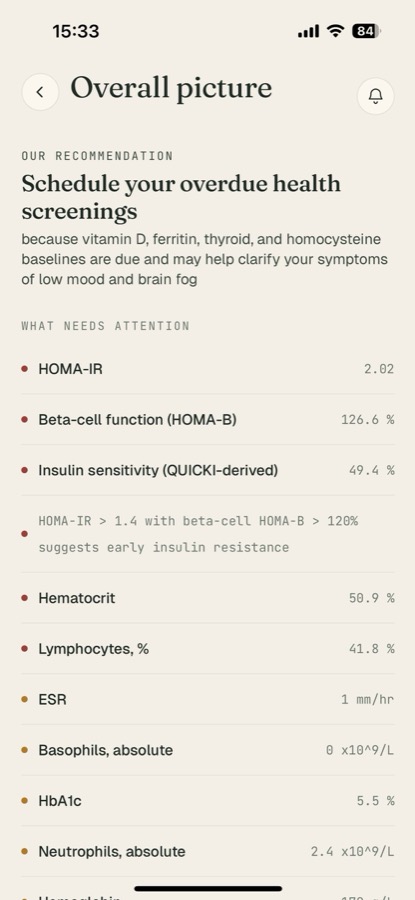
B12 is a classic case where a borderline number plus real symptoms is the story — and that’s exactly what gets lost between a lab PDF and a two-minute appointment. Bevita tracks B12 (with related markers like MMA and homocysteine if you have them), flags values against functional ranges rather than just the wide lab range, and ties them to symptoms you log like fatigue or tingling — so a gray-zone B12 doesn’t get waved off.
What to do
- Ask for serum B12 — and MMA/homocysteine if it’s borderline or symptoms persist.
- Know your risk group — older age, plant-based diet, metformin/acid reducers all warrant checking.
- Don’t ignore neurological signs — tingling and numbness deserve prompt attention.
- Talk to a clinician about the cause and whether oral or injected B12 is appropriate.
References
- NIH Office of Dietary Supplements. Vitamin B12 — Health Professional Fact Sheet.
- Ankar A, Kumar A. Vitamin B12 Deficiency. StatPearls, NCBI.
- NIH Office of Dietary Supplements. Iron — Health Professional Fact Sheet.
This article is for education and isn’t medical advice. Discuss your results with a qualified clinician.
Track your B12 with Bevita
A borderline B12 with real symptoms shouldn’t slip through. Upload your labs to Bevita and it tracks B12 against functional ranges, ties it to the fatigue or fog you log, and shows the trend over time. Download Bevita, upload your bloodwork, and find out if B12 is behind how you feel.