Ferritin gets all the attention in iron testing, and for good reason — it’s the best single marker of your iron stores. But “best single marker” isn’t the same as “the whole story.” A full iron panel adds three more numbers that, read together, distinguish genuine iron deficiency from other explanations and catch cases ferritin alone would miss.
The stat most people don’t know
Iron deficiency is the most common nutritional deficiency in the world, affecting up to a quarter of the global population (WHO). Yet it’s frequently under-diagnosed, partly because a single “normal” ferritin can be reassuring while missing the fuller picture — especially when inflammation is in play.
The four markers and what each adds
- Ferritin — your iron stores. The reservoir. Low ferritin is the earliest and most specific sign of depleted iron; below ~30 ng/mL is highly specific for deficiency (AAFP). (See what low ferritin means and the ferritin levels chart.)
- Serum iron — iron circulating right now. A snapshot of iron currently in your blood. It fluctuates through the day and with recent meals, so it’s weak on its own.
- TIBC (total iron-binding capacity) — spare capacity. Measures how much your transport protein (transferrin) could carry. TIBC tends to rise when iron is low (the body makes more transporters to grab what iron it can).
- Transferrin saturation — the percentage filled. Serum iron divided by capacity. Normal is roughly 20–50%; below ~20% points to iron deficiency (NIH Office of Dietary Supplements).
Why the panel beats ferritin alone
The big reason is inflammation. Ferritin is an acute-phase reactant — it rises with infection, inflammation, or liver issues. So someone who’s genuinely iron deficient and has some inflammation can show a ferritin that looks “normal,” hiding the problem.
That’s where transferrin saturation earns its place: a low transferrin saturation alongside a normal-looking ferritin can reveal iron deficiency that ferritin alone would have missed. The pattern across all four markers tells you what’s really going on.
Reading the patterns
- Iron deficiency: low ferritin, low serum iron, high TIBC, low transferrin saturation
- Iron deficiency with inflammation: ferritin may be normal/high, but transferrin saturation stays low
- Iron overload: high ferritin, high serum iron, high transferrin saturation
What this looks like in Bevita
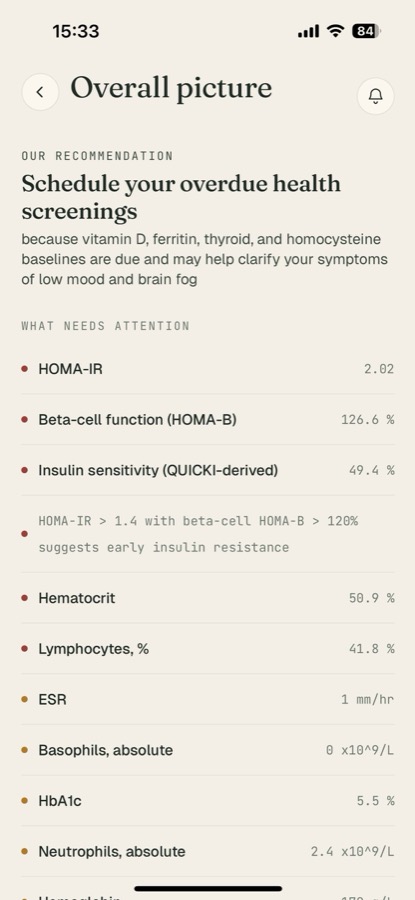
The whole point of an iron panel is that the markers only make sense together — a job a stack of separate lab values makes needlessly hard. Bevita reads ferritin, serum iron, TIBC, and transferrin saturation as one picture, flags the pattern (deficiency vs overload vs masked-by-inflammation), and tracks them over time, so a slowly declining iron status becomes visible before it turns into anemia.
What to do
- Ask for the full panel — ferritin, serum iron, TIBC, and transferrin saturation — not just ferritin.
- Watch transferrin saturation if you have inflammation, which can inflate ferritin.
- Track over time — iron status shifts gradually; the trend is the story.
- Talk to a clinician before supplementing — too much iron is also harmful.
References
- World Health Organization. Anaemia.
- Short MW, Domagalski JE. Iron Deficiency Anemia: Evaluation and Management. AAFP.
- NIH Office of Dietary Supplements. Iron — Health Professional Fact Sheet.
This article is for education and isn’t medical advice. Discuss your results with a qualified clinician.
Track your iron panel with Bevita
Iron markers only make sense read together and over time. Upload your labs to Bevita and it tracks ferritin, serum iron, TIBC, and transferrin saturation as one picture, flags the pattern, and shows the trend. Download Bevita, upload your bloodwork, and see your full iron status.