You got a fasting insulin result and went looking for what it means. One page says the normal range goes up to 25. Another says anything over 10 is insulin resistance. A third insists optimal is under 5. They can’t all be right, and the temptation is to assume somebody is being sloppy.
They aren’t, exactly. There’s a specific, unglamorous reason the numbers disagree, and once you know it, your own result becomes much easier to read.
The stat most people don’t know
Insulin assays were never standardized. Unlike glucose or HbA1c, which are traceable to common reference methods, insulin immunoassays from different manufacturers measure the same blood sample and return meaningfully different answers. A comparison of eleven human insulin assays found disagreement large enough to affect clinical and research conclusions (Clinical Chemistry, PubMed), and a later kit comparison reported relative standard deviations between roughly 2% and 23% (Rosli et al., J Clin Lab Anal / PMC).
The consequence is the thing nobody mentions when they quote you a cutoff: because of that variability and the lack of standardization, the specific insulin levels corresponding to specific degrees of insulin resistance have never been formally defined. The American Diabetes Association convened a workgroup specifically on standardizing insulin immunoassays because of it.
So the conflicting ranges online aren’t a fight between right and wrong. They’re different labs, different assays, and different conventions, all reported as if they were universal.
The numbers you’ll actually encounter
With that caveat attached, here’s the landscape:
- Typical lab reference interval — roughly 2.6–24.9 µIU/mL. Wide, and derived from a general population that includes plenty of people with undiagnosed metabolic problems. “In range” here is a weak reassurance.
- A proposed narrower interval — an analysis of a large clinical laboratory database suggested about 2.5–13.1 µU/mL for fasting insulin, with HOMA-IR around 0.4–2.9 (PMC).
- Common metabolic-health practice — under about 5–8 µIU/mL treated as optimal, 10 and above as suggestive of early insulin resistance. Useful as a working heuristic; not a guideline threshold.
- HOMA-IR — a calculated index combining fasting insulin and fasting glucose, with cutoffs commonly placed around 2.0–2.5, though these also shift with age, sex, and ethnicity.
Note how the “optimal” figures sit deep inside the lab’s normal range. That gap is the whole reason fasting insulin is worth ordering at all, and why a result can be technically normal while telling you something.
Why a ratio survives what a raw number doesn’t
HOMA-IR is more robust than raw insulin for a reason worth understanding: it pairs insulin with glucose measured on the same sample, so it describes a relationship rather than an absolute quantity. It’s still affected by assay variability — reported HOMA-IR coefficients of variation track the insulin assay used — but the relationship carries more information than the number alone.
This is the same logic behind the triglyceride-to-HDL ratio, which works as an insulin-resistance surrogate precisely because it compares two markers instead of reading one. Single numbers lie; relationships and directions are much harder to fake.
For the wider picture on what insulin resistance looks like across several markers, see how to know if you have insulin resistance, and why your doctor probably skipped this test for the case for ordering it. If you have PCOS, the insulin markers worth checking are somewhat different.
The rule that actually works
Given non-standardized assays, there’s one practical response, and it’s not finding a better cutoff online:
Use the same lab every time, and compare yourself to yourself.
Your fasting insulin going 14 → 11 → 8 across a year on the same assay is real information, regardless of which reference interval that lab prints. Your insulin measured at 9 by one lab versus 13 by another tells you close to nothing about whether anything changed.
What this looks like in Bevita
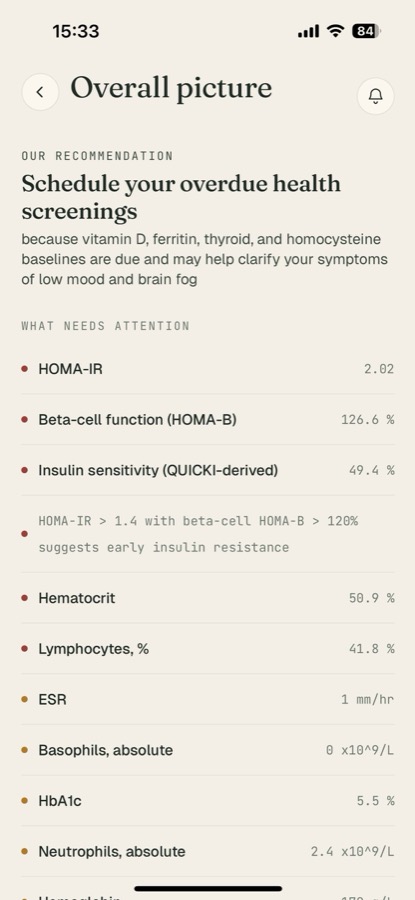
This is exactly the problem Bevita is built around. On this “Overall picture” screen, fasting insulin isn’t a lone value — it’s combined with glucose into HOMA-IR and placed in context with the rest of your metabolic markers.
Because Bevita keeps every upload with its date and source, your own history becomes the reference range that actually applies to you. It calculates the derived indices for you, so you don’t have to remember the HOMA-IR formula or dig out last year’s PDF to see whether the number is moving. Given that no universal insulin cutoff exists, your own trend is the most trustworthy comparison available.
What to do
- Get the number, the units, and the lab’s own interval. µIU/mL and pmol/L differ by roughly a factor of 6 — check which you’re reading.
- Ask for fasting glucose from the same draw so HOMA-IR can be calculated.
- Stick to one lab for anything you intend to track.
- Don’t be reassured by “normal” if you’re in the teens with symptoms — the standard interval is wide by construction.
- Talk to a clinician, particularly if fasting insulin is elevated alongside rising HbA1c, triglycerides, or waist circumference.
References
- Manley SE, et al. Comparison of 11 Human Insulin Assays: Implications for Clinical Investigation and Research. Clinical Chemistry.
- Rosli NF, et al. Measurement comparability of insulin assays using conventional immunoassay kits. Journal of Clinical Laboratory Analysis.
- Proposal for fasting insulin and HOMA-IR reference intervals based on an extensive Brazilian laboratory database. PMC.
- Freeman AM, et al. Insulin Resistance. StatPearls, NCBI Bookshelf.
This article is for education and isn’t medical advice. Discuss your results with a qualified clinician.
Make your own history the reference range
No universal fasting insulin cutoff exists — which makes your personal trend the number that matters. Upload your labs to Bevita and it stores every insulin and glucose result, calculates HOMA-IR for you, and charts where you’re heading. Download Bevita, upload your results, and stop guessing which internet range applies to you.