You open your lab report and the line doesn’t say “TSH.” It says “TSH, ultrasensitive” — or “uTSH,” or “TSH, 3rd generation.” Naturally you wonder whether your doctor ordered something more serious, or whether a special range applies to you.
Neither. It’s the same hormone, measured on a better instrument. The confusing part is that the improvement only helps in one direction — and probably not the direction you care about.
The stat most people don’t know
The earliest TSH tests were nearly useless for the thing thyroid testing is now famous for. First-generation radioimmunoassays had a detection limit of around 1.0 mIU/L (Endotext, NCBI Bookshelf) — which sits inside the normal range. They physically could not distinguish a healthy person from someone with an overactive thyroid, so diagnosing hyperthyroidism required a separate TRH stimulation test.
Third-generation assays measure reliably down to roughly 0.01–0.02 mIU/L (Spencer et al., NCBI Bookshelf; Utility of third-generation thyrotropin assays, PubMed). That’s about a hundredfold improvement, and it’s why the extra test was retired. “Ultrasensitive” is the marketing name for that generation of assay.
What “sensitive” technically means here
Sensitivity in lab medicine isn’t vague. Functional sensitivity is the lowest concentration an assay can measure with acceptable reproducibility — conventionally, where the coefficient of variation stays under 20%. Third-generation TSH assays hold that standard down to about 0.01 mIU/L.
So the assay generations are essentially a ladder of how far down they can see:
- 1st generation — detection limit ~1.0 mIU/L
- 2nd generation — roughly 0.1 mIU/L
- 3rd generation (“ultrasensitive”) — roughly 0.01–0.02 mIU/L
Most labs in developed healthcare systems now run third-generation or better as standard. If your report says ultrasensitive, you’re getting the normal modern test, not an upgrade someone paid extra for.
Why the extra precision is at the bottom
Here’s the part that resolves most of the confusion. All that sensitivity is spent below the reference range.
TSH works backwards from what people expect: it goes up when the thyroid is underactive and down when the thyroid is overactive. When the thyroid is overactive, the pituitary stops asking for hormone and TSH falls toward zero. The clinical question then becomes how close to zero — a TSH of 0.2 (mildly low) carries different weight than 0.005 (fully suppressed, as in overt hyperthyroidism).
An older assay reported both as “undetectable.” An ultrasensitive assay tells them apart. That distinction matters for judging severity and for monitoring people on thyroid hormone replacement, where over-replacement pushes TSH down.
Which means: if your TSH is high, the “ultra” prefix is irrelevant to your interpretation. A TSH of 7 is a TSH of 7. The reasons it rose, and what to do about it, don’t change — see what causes a high TSH and high TSH symptoms.
The reference range didn’t change
The adult reference range remains roughly 0.4–4.0 mIU/L, and it genuinely varies between labs — reported euthyroid intervals for specific third-generation platforms have come in around 0.30–3.68 and 0.36–3.64 mU/L (PubMed). Ranges also shift with age, pregnancy, and the population the lab used to establish them.
This is the trap in comparing a TSH from one lab to a TSH from another. The assays are more sensitive than they used to be, but they are still not perfectly harmonized between manufacturers — an ongoing standardization effort in laboratory medicine (TSH Harmonization, myADLM). A jump from 3.2 to 3.9 across two different labs may be the labs, not your thyroid.
For what the number means once you have it, start with what a high TSH actually indicates, and free T3 and free T4 for the hormones TSH is regulating.
What this looks like in Bevita
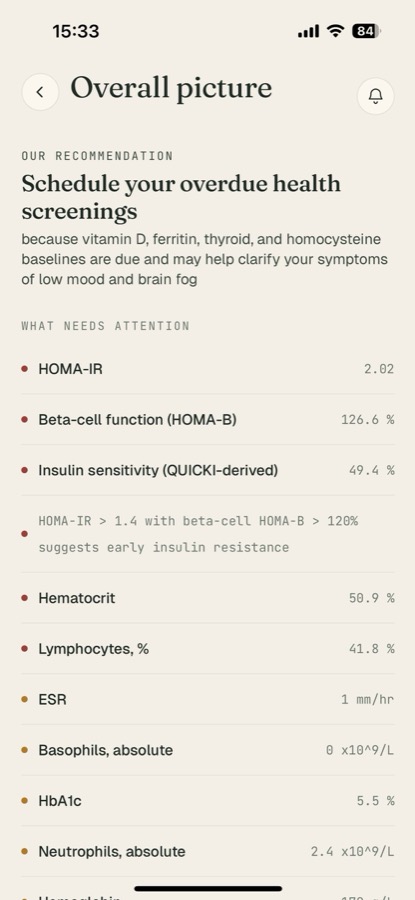
The single number is the least interesting thing about a TSH result. On this Bevita “Overall picture” screen, thyroid sits next to the other systems and is read against logged symptoms rather than in isolation.
That’s the practical answer to the lab-comparability problem above. Bevita keeps every result you upload with its date, so you see your own TSH trajectory instead of trying to remember whether last year’s number was 2 or 4 — and whether the direction of travel matches how you’ve been feeling. A slow drift upward across three draws is a signal. One reading, from one lab, on one morning, mostly isn’t.
What to do
- Don’t read the label as a diagnosis. “Ultrasensitive” describes the instrument, not your result.
- Get the number and the lab’s own range, not just “normal” — ranges differ between labs.
- Ask for free T4 alongside it if TSH is out of range. TSH alone can’t separate the pituitary’s signal from the thyroid’s output.
- Compare against your own history, ideally from the same lab, rather than against a number a friend quoted.
- Talk to a clinician about anything outside the range, and especially about a TSH that’s moving consistently in one direction.
References
- Spencer CA. Assay of Thyroid Hormone and Related Substances. Endotext, NCBI Bookshelf.
- Utility of third generation thyrotropin assays in thyroid function testing. PubMed.
- Pierce E, et al. Physiology, Thyroid Stimulating Hormone. StatPearls, NCBI Bookshelf.
- TSH Harmonization. Clinical Laboratory News, myADLM.
This article is for education and isn’t medical advice. Discuss your results with a qualified clinician.
See your own TSH trend with Bevita
An ultrasensitive assay gives you a precise number on one day. What it can’t give you is direction. Upload your labs to Bevita and it keeps every TSH and free T4 you’ve ever had, charts the trend, and reads it against the symptoms you log. Download Bevita, upload your thyroid results, and find out which way your TSH has actually been heading.