Of all the numbers on a lipid panel, triglycerides are the one most tied to what you eat and how your metabolism is running. Cholesterol gets the attention, but a high triglyceride level is often the earliest and most responsive signal of a metabolic problem brewing — and it’s frequently glossed over.
What triglycerides are
Triglycerides are the main form of fat in your blood and your body’s main way of storing and transporting energy. After a meal — especially one high in carbs, sugar, or alcohol — triglycerides rise as that energy is packaged up. Chronically high levels mean the system that clears them isn’t keeping up, which is often an insulin problem.
What the numbers mean
- Below 150 mg/dL — normal
- 150–199 mg/dL — borderline high
- 200–499 mg/dL — high
- 500+ mg/dL — very high (and a pancreatitis risk at the top end)
They’re measured fasting, because they spike after eating (American Heart Association). A level over 150 is also one of the five criteria for metabolic syndrome.
The stat most people don’t know
High triglycerides rarely travel alone. Paired with a low HDL, they form one of the clearest lipid signatures of insulin resistance — so much so that the triglyceride-to-HDL ratio is used as a surrogate marker for it (Kim-Dorner et al., NCBI). In other words, an elevated triglyceride number is often waving a flag about your blood sugar and insulin, not just your heart.
Why they rise
The main drivers are highly modifiable:
- Refined carbs and added sugar — the biggest dietary lever; the liver converts excess into triglycerides
- Alcohol — raises triglycerides significantly, even in moderate amounts for some people
- Insulin resistance — impairs triglyceride clearance (fasting insulin is worth checking)
- Excess weight and inactivity
- Poorly controlled diabetes and certain medications
The upside of all that: because triglycerides respond so quickly to diet and insulin sensitivity, they often drop fast with the right changes — making them a satisfying marker to track.
What this looks like in Bevita
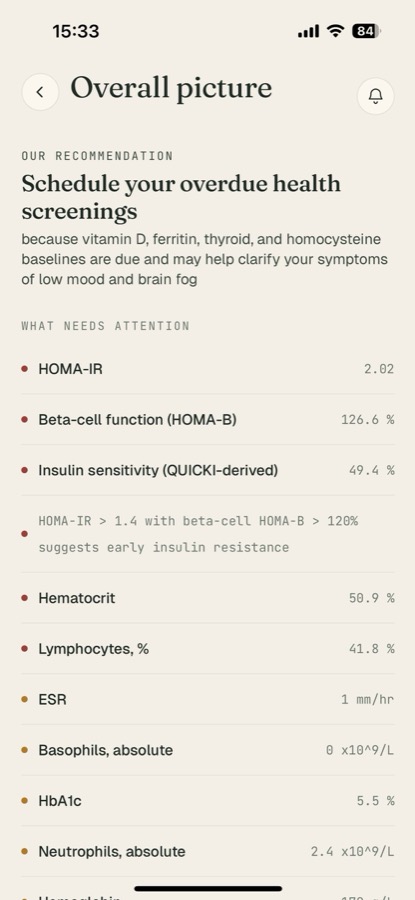
A triglyceride number means far more read next to your HDL and insulin markers than alone. Bevita calculates your triglyceride-to-HDL ratio automatically, flags triglycerides against the thresholds, and tracks them alongside HOMA-IR and glucose — so a high level reads as the metabolic signal it usually is, and you can watch it fall as you change diet and activity.
What to do
- Get a fasting triglyceride level — non-fasting readings run higher.
- Read it with HDL and insulin — the ratio reveals the metabolic angle.
- Target the drivers — refined carbs, sugar, and alcohol are the fastest levers.
- Re-test after changes — triglycerides move quickly, so they show progress fast. Talk to a clinician, especially if very high.
References
- American Heart Association. HDL, LDL Cholesterol and Triglycerides.
- Kim-Dorner SJ, et al. Triglycerides-to-HDL cholesterol ratio and insulin resistance. NCBI / PMC.
- National Heart, Lung, and Blood Institute (NHLBI). Blood Cholesterol.
This article is for education and isn’t medical advice. Discuss your results with a qualified clinician.
Track your triglycerides with Bevita
Triglycerides are a fast-moving marker worth watching. Upload your labs to Bevita and it flags them against the thresholds, calculates your triglyceride-to-HDL ratio, and tracks the trend beside your metabolic markers. Download Bevita, upload your lipid panel, and watch the number respond.