“LDL is the bad one, HDL is the good one” is the cholesterol lesson almost everyone remembers. It’s a decent starting point — but treating it as the whole story is exactly how people end up with a “normal” cholesterol and a false sense of security. The nuance between these two carries most of the actual risk information.
What each one actually does
Cholesterol doesn’t dissolve in blood, so it travels packaged in particles called lipoproteins:
- LDL (low-density lipoprotein) — carries cholesterol out to the body. When there’s excess, LDL particles can lodge in artery walls and drive plaque. Hence “bad.” Generally, higher LDL = higher cardiovascular risk.
- HDL (high-density lipoprotein) — helps carry cholesterol back to the liver for disposal. Hence “good.” Generally, higher HDL = protective (American Heart Association).
The target numbers
- LDL: below 100 mg/dL is optimal (lower if you’re higher risk)
- HDL: above 40 mg/dL (men) / 50 mg/dL (women) is desirable
- Total cholesterol: below 200 mg/dL — but this is the least informative number, because it blends LDL and HDL together
The stat most people don’t know
Cardiovascular disease is the leading cause of death worldwide (WHO) — and a large share of people who have heart attacks have a “normal” total cholesterol. That’s the trap of judging risk by one number: a total of 195 can look reassuring while hiding a low HDL with high triglycerides, a genuinely higher-risk pattern.
The nuance that matters
Here’s where “good vs bad” gets more useful:
- LDL number vs LDL particles. Two people can have the same LDL cholesterol but a very different number of particles — and particle number drives risk more than the cholesterol they carry. That’s why ApoB is increasingly seen as a better marker than LDL-C.
- HDL isn’t a dial to maximize. Higher is generally better, but very high HDL doesn’t keep adding benefit, and trials to force HDL up haven’t reduced risk. Read it as context, not a target to game.
- The ratio tells you about metabolism. A low HDL with high triglycerides — captured by the triglyceride-to-HDL ratio — is a signature of insulin resistance, not just heart risk.
What this looks like in Bevita
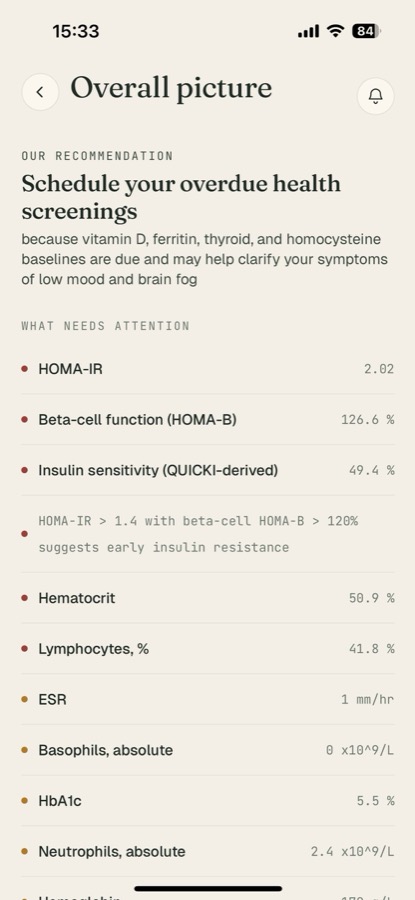
LDL and HDL only mean something in relation to each other, to your triglycerides, and over time — which is exactly what a single lab report leaves you to work out. Bevita tracks LDL, HDL, triglycerides (and ApoB if you have it) together, calculates the ratios that matter, flags each against optimal ranges, and shows the trend across tests — so “your cholesterol is fine” becomes an actual picture of where your risk sits and where it’s heading.
What to do
- Get the individual numbers — LDL, HDL, and triglycerides, not just total cholesterol.
- Read them together — a low HDL with high triglycerides matters even if LDL looks okay.
- Ask about ApoB if you want a more precise risk read than LDL-C alone.
- Track over time and talk to a clinician about your overall cardiovascular risk.
References
- American Heart Association. HDL (Good), LDL (Bad) Cholesterol and Triglycerides.
- World Health Organization. Cardiovascular diseases (CVDs).
- National Heart, Lung, and Blood Institute (NHLBI). Blood Cholesterol.
This article is for education and isn’t medical advice. Discuss your results with a qualified clinician.
Track your cholesterol with Bevita
LDL and HDL make sense as a full picture — with your triglycerides, your ratios, and the trend over time. Upload your labs to Bevita and it reads the whole lipid panel together, flags optimal-vs-normal, and tracks every number. Download Bevita and see what your cholesterol actually means.