TSH 4.8: What This Level Means
A TSH of 4.8 is just above the reference range, the most common abnormal thyroid result there is. What it means, and what to test before deciding.
Just above the reference rangeWhere 4.8 sits
At 4.8 mIU/L you are 0.8 above the 4 ceiling of the reference range — about 1.2× the upper limit — and 5.2 below 10, the level at which treatment for an underactive thyroid is usually recommended.So this sits in the gap where the decision is a judgement rather than a rule. A further rise of 5.2 would cross into the range where levothyroxine is normally started; a fall of 0.8 would bring you back inside normal.
| Your value | 4.8 mIU/L |
|---|---|
| Usual reference range | 0.4 – 4 mIU/L (varies by lab) |
| Where it falls | Just above the reference range |
| Treatment threshold | Usually around 10 mIU/L for an underactive thyroid |
What a TSH of 4.8 means
This is the mildest abnormal result on the high side. It clears the top of the range but only barely, and it is the single most common abnormal thyroid result there is.
When free T4 is still normal, this is subclinical hypothyroidism at its earliest. A meaningful share of results in this band normalise on their own — which is exactly why guidance leans on repeating the test before doing anything else.
Symptoms at this level are usually absent or mild, and where they exist they overlap heavily with iron deficiency and vitamin D deficiency. That overlap is worth taking seriously before attributing everything to the thyroid.
What causes a marginally raised TSH
- Hashimoto's thyroiditis — the most common cause, confirmed with TPO antibodies
- Transient elevation after illness, which resolves without treatment
- Recovery from thyroiditis
- Slight under-replacement, if you take levothyroxine
- Assay interference or biotin supplements, an occasional false high
Does a TSH of 4.8 need treatment?
Repeat the test in six to twelve weeks with free T4 and TPO antibodies before any decision. Treatment at this level is the exception rather than the rule, and it becomes more likely with positive antibodies, clear symptoms, a rising trend, or pregnancy.
What to test alongside it
- Free T4 — normal keeps this subclinical rather than overt
- TPO antibodies — identifies Hashimoto's and predicts whether it will progress
- A repeat TSH after 6-12 weeks, before concluding anything
- Ferritin and vitamin D, which often explain the symptoms better than the thyroid does
How soon to act
Not urgent, but do book the follow-up rather than filing it away. Raise it promptly if you are pregnant or trying to conceive.
Why one reading is never the whole story
TSH moves. It peaks overnight and early in the morning, shifts with illness and with the laboratory doing the measuring, and responds slowly to any real change — which is why a single value of 4.8 is a starting point rather than a conclusion. The same number means one thing if it has been stable for years and something quite different if it has been climbing across your last three tests.
What this looks like in Bevita
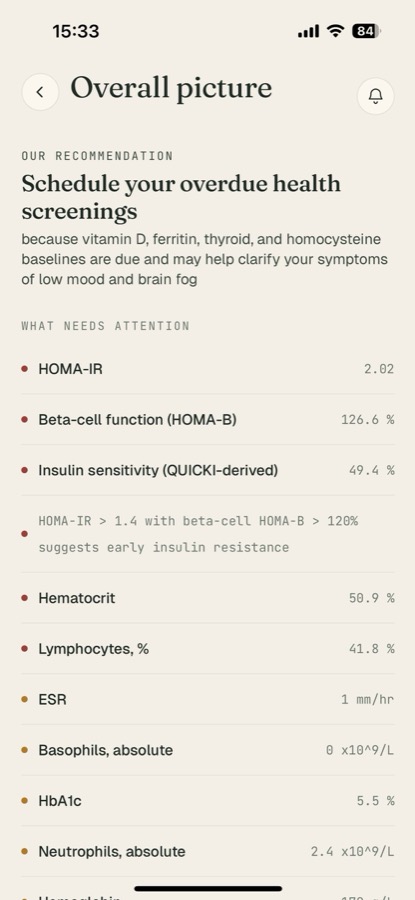
This is the part a single result cannot give you. Bevita keeps every lab report you upload with its date, so your TSH becomes a line rather than a number — and reads it next to free T4 and the symptoms you log instead of in isolation.
Upload the report this value came from and you will see where 4.8 sits against your own history, not just against a reference range built from strangers.
Related reading
- high TSH: what your thyroid is telling you
- the common causes of an elevated TSH
- testing for Hashimoto's with TPO antibodies
- what low ferritin actually means
Nearby TSH values
- TSH 2.5 Upper-middle of normal
- TSH 3.5 High-normal
- TSH 3.9 Top of the normal range
- TSH 5.5 Mild subclinical hypothyroidism
- TSH 8.8 Approaching the treatment threshold
- TSH 11 Overt hypothyroidism range
References
- National Institute of Diabetes and Digestive and Kidney Diseases. Hypothyroidism.
- Subclinical Hypothyroidism. StatPearls, NCBI.
- Ettleson MD, et al. Trends in Prevalence of Thyroid Dysfunction. J Clin Endocrinol Metab.
This page is for education and isn't medical advice. Reference ranges vary between laboratories — check the range printed on your own report, and discuss your results with a qualified clinician.
Frequently asked questions
- Is a TSH of 4.8 normal?
- No — 4.8 mIU/L falls outside the usual reference range of about 0.4 to 4 mIU/L. It sits in what is generally described as the just above the reference range. Reference ranges do vary between laboratories, so compare against the range printed on your own report.
- Does a TSH of 4.8 need treatment?
- Repeat the test in six to twelve weeks with free T4 and TPO antibodies before any decision. Treatment at this level is the exception rather than the rule, and it becomes more likely with positive antibodies, clear symptoms, a rising trend, or pregnancy.
- What should I test alongside a TSH of 4.8?
- Free T4, TPO antibodies, A repeat TSH after 6-12 weeks, before concluding anything, Ferritin and vitamin D, which often explain the symptoms better than the thyroid does. TSH on its own cannot separate the pituitary's signal from the thyroid's actual output, which is why free T4 is the usual companion test.
See what your TSH has actually been doing
Upload your lab reports to Bevita and it tracks your TSH and free T4 across every test, reads them together, and ties them to how you've been feeling. Free to start.
Download on the App Store