TSH 3.5: What This Level Means
A TSH of 3.5 falls in the most-debated stretch of the normal range. Whether that matters, what causes it, and which tests settle the question.
High-normalWhere 3.5 sits
At 3.5 mIU/L you are inside the usual 0.4–4 range: 3.1 above the floor and 0.5 below the ceiling, which puts you about 86% of the way up the reference band.A rise of 0.5 would take you out of range at the top; a fall of 3.1 would take you out at the bottom. Neither is a large movement for a marker that varies through the day, which is why one reading is a starting point rather than a verdict.
| Your value | 3.5 mIU/L |
|---|---|
| Usual reference range | 0.4 – 4 mIU/L (varies by lab) |
| Where it falls | High-normal |
| Treatment threshold | Usually around 10 mIU/L for an underactive thyroid |
What a TSH of 3.5 means
Your report will say normal, and by the standard reference range it is. But this sits in the most-debated stretch of the entire thyroid panel — high enough that some clinicians would want a repeat and antibodies, low enough that many would not comment at all.
The reason the disagreement exists is that reference intervals describe whoever was sampled, and those samples contained people with early undiagnosed thyroid disease. Narrower ranges have been proposed on exactly that basis without becoming consensus.
What makes a value here meaningful is direction rather than magnitude. A 3.2 that was 1.3 two years ago tells a story; a 3.2 that has been flat for a decade tells you this is just your number.
What can put TSH in the high-normal band
- Early autoimmune thyroiditis, drifting upward over years before crossing the line
- Individual set point — plenty of healthy people simply run here
- Diurnal variation — TSH peaks overnight and early morning
- Iodine or selenium status, occasionally relevant at the margins
- Ageing, which shifts TSH gently upward
Does a TSH of 3.5 need treatment?
Treatment is not standard inside the reference range. The informative move is a repeat with free T4 and TPO antibodies, weighted by symptoms, family history and whether pregnancy is on the horizon.
What to test alongside it
- TPO antibodies — the single most useful test here
- Free T4 to confirm hormone output is holding
- A repeat TSH in three to six months, drawn at a similar time of day
How soon to act
Not urgent, with the pregnancy exception. Treat it as a baseline to compare against rather than a problem to solve.
Why one reading is never the whole story
TSH moves. It peaks overnight and early in the morning, shifts with illness and with the laboratory doing the measuring, and responds slowly to any real change — which is why a single value of 3.5 is a starting point rather than a conclusion. The same number means one thing if it has been stable for years and something quite different if it has been climbing across your last three tests.
What this looks like in Bevita
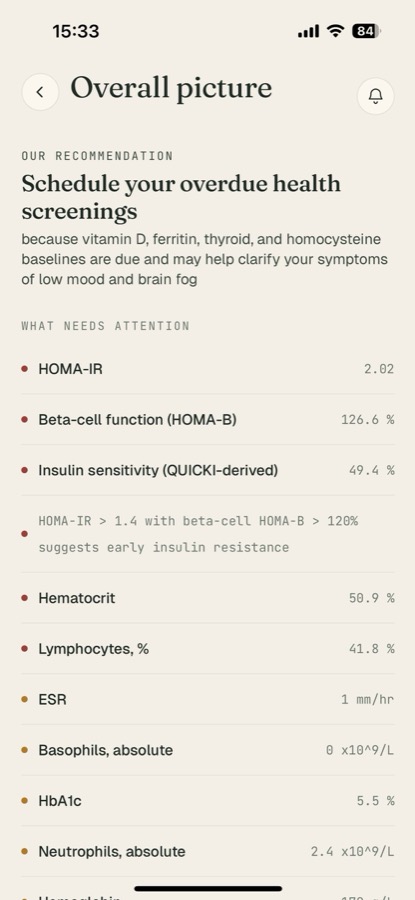
This is the part a single result cannot give you. Bevita keeps every lab report you upload with its date, so your TSH becomes a line rather than a number — and reads it next to free T4 and the symptoms you log instead of in isolation.
Upload the report this value came from and you will see where 3.5 sits against your own history, not just against a reference range built from strangers.
Related reading
- high TSH: what your thyroid is telling you
- testing for Hashimoto's with TPO antibodies
- what an underactive thyroid feels like
Nearby TSH values
- TSH 0.5 Low end of normal
- TSH 1.5 Mid-normal
- TSH 2.5 Upper-middle of normal
- TSH 3.9 Top of the normal range
- TSH 4.8 Just above the reference range
- TSH 5.5 Mild subclinical hypothyroidism
References
- National Institute of Diabetes and Digestive and Kidney Diseases. Hypothyroidism.
- Ettleson MD, et al. Trends in Prevalence of Thyroid Dysfunction. J Clin Endocrinol Metab.
This page is for education and isn't medical advice. Reference ranges vary between laboratories — check the range printed on your own report, and discuss your results with a qualified clinician.
Frequently asked questions
- Is a TSH of 3.5 normal?
- Yes — 3.5 mIU/L falls inside the usual reference range of about 0.4 to 4 mIU/L, so it is reported as normal. Ranges vary slightly between laboratories, and this value sits in the high-normal part of that range.
- Does a TSH of 3.5 need treatment?
- Treatment is not standard inside the reference range. The informative move is a repeat with free T4 and TPO antibodies, weighted by symptoms, family history and whether pregnancy is on the horizon.
- What should I test alongside a TSH of 3.5?
- TPO antibodies, Free T4 to confirm hormone output is holding, A repeat TSH in three to six months, drawn at a similar time of day. TSH on its own cannot separate the pituitary's signal from the thyroid's actual output, which is why free T4 is the usual companion test.
See what your TSH has actually been doing
Upload your lab reports to Bevita and it tracks your TSH and free T4 across every test, reads them together, and ties them to how you've been feeling. Free to start.
Download on the App Store