Your TSH came back at 4.2. The lab says the normal range is 0.4-4.0. Your doctor says it’s “slightly elevated” and wants to retest in 6 months.
What does that actually mean?
What TSH is
TSH (Thyroid Stimulating Hormone) is produced by your brain (pituitary gland) to tell your thyroid to produce hormones. Think of it like a thermostat:
- Low TSH = your brain thinks you have enough thyroid hormone → thyroid slows down
- High TSH = your brain thinks you don’t have enough → thyroid speeds up
So TSH is actually measuring your brain’s signal, not your thyroid’s output directly.
What the numbers mean
| TSH Level | What It Suggests |
|---|---|
| Below 0.4 | Possible hyperthyroidism (overactive thyroid) |
| 0.4-2.5 | Optimal range for most people |
| 2.5-4.0 | Gray zone — may be subclinical |
| 4.0-10.0 | Likely subclinical hypothyroidism |
| Above 10.0 | Overt hypothyroidism — treatment usually needed |
Ranges vary a little between laboratories, and if your report is labelled “ultrasensitive” or “3rd generation,” that describes the assay rather than your result — see what ultrasensitive TSH actually means.
Looking for your exact number? Browse TSH levels by value for what a specific result means, what tends to cause it, and which tests belong alongside it.
Why “slightly elevated” matters
A TSH of 4.2 isn’t dangerous. But it’s not nothing either.
Subclinical hypothyroidism (TSH 4.0-10.0 with normal T4) affects roughly 5-10% of adults, and prevalence rises with age (Ettleson et al., J Clin Endocrinol Metab; NIDDK). Symptoms include:
- Fatigue that doesn’t improve with sleep
- Unexplained weight gain
- Cold sensitivity
- Dry skin and hair
- Brain fog
- Constipation
Many people with subclinical hypothyroidism feel fine. But if you have symptoms, it’s worth monitoring — especially if TSH is trending upward.
Go deeper on high TSH: what causes it · the full symptom list · the unusual high-TSH-with-high-T4 pattern · what a TSH over 100 means · why hyperthyroidism makes TSH low, not high · free T3 & T4 beyond TSH · thyroid antibodies (Hashimoto’s).
When to worry
- TSH above 10.0 — treatment usually recommended
- TSH 4.0-10.0 + symptoms — worth discussing with your doctor
- TSH trending upward over months — even if still “normal”
- TSH below 0.4 — possible hyperthyroidism, needs evaluation
The trend matters more than the number
A TSH of 3.8 that was 1.5 a year ago is more concerning than a TSH of 4.2 that’s been stable for 3 years. Your doctor should be looking at the direction, not just the snapshot.
This is why tracking your results over time is so important. A single TSH result tells you where you are. Three results over 18 months tell you where you’re heading.
What this looks like in Bevita
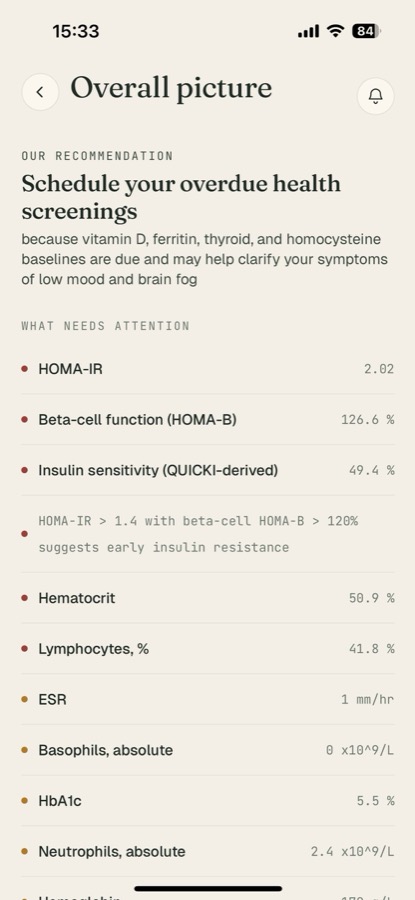
This is the gap Bevita is built to close. On this “Overall picture” screen, thyroid isn’t a lone value on a page — it’s flagged in context and tied directly to the symptoms you’ve logged, like low mood and brain fog.
Upload each lab report as you get it and Bevita keeps every TSH with its date, so the trend is already drawn the next time you look. Instead of hunting through PDFs to remember whether last year’s TSH was 1.5 or 3.8, you see the direction — and whether it lines up with how you’ve actually been feeling. That’s the difference between “slightly elevated, retest in six months” and knowing what’s happening.
References
- National Institute of Diabetes and Digestive and Kidney Diseases (NIDDK). Hypothyroidism (Underactive Thyroid).
- Ettleson MD, et al. Trends in Prevalence of Thyroid Dysfunction. Journal of Clinical Endocrinology & Metabolism.
- American Thyroid Association. Hypothyroidism.
This article is for education and isn’t medical advice. Discuss your results with a qualified clinician.
Track your thyroid with Bevita
Bevita tracks your TSH (and T3, T4, and antibodies) over time, shows you the trend, and flags when it’s time to retest. No more guessing whether that number is going up or down.
Free tier. Upload your first lab result in 30 seconds.