TSH 0.5: What This Level Means
A TSH of 0.5 is normal, toward the lower end of the range. What that means, when a low-normal TSH matters, and what to check if you feel unwell.
Low end of normalWhere 0.5 sits
At 0.5 mIU/L you are inside the usual 0.4–4 range: 0.1 above the floor and 3.5 below the ceiling, which puts you about 3% of the way up the reference band.A rise of 3.5 would take you out of range at the top; a fall of 0.1 would take you out at the bottom. Neither is a large movement for a marker that varies through the day, which is why one reading is a starting point rather than a verdict.
| Your value | 0.5 mIU/L |
|---|---|
| Usual reference range | 0.4 – 4 mIU/L (varies by lab) |
| Where it falls | Low end of normal |
| Treatment threshold | Usually around 10 mIU/L for an underactive thyroid |
What a TSH of 0.5 means
This is a normal result sitting toward the lower end of the range. For most people it means the thyroid is producing hormone comfortably and the pituitary has no need to push.
One context changes how this is read: if you take levothyroxine, a TSH down here can indicate a dose slightly higher than you need, since replacement often aims for the middle of the range rather than the bottom. Untreated, it is simply a healthy number.
What a result here usually reflects
- Normal thyroid function with a naturally lower set point
- Thyroid replacement dosed toward the higher end of what you need
- Time of day — afternoon and evening draws run lower
- No indication of an underactive thyroid, which is the main thing this rules out
Does a TSH of 0.5 need treatment?
Nothing to treat. If you take thyroid medication and feel over-stimulated — jittery, sleeping poorly, heart racing — it is worth reviewing the dose against this result rather than assuming it is unrelated.
What to test alongside it
- Free T4, if you take thyroid medication, to check you are not over-replaced
- Ferritin, vitamin D and B12 if you have symptoms, since a normal TSH points elsewhere
How soon to act
No urgency. This is a reassuring thyroid result; persistent symptoms need a different line of enquiry.
Why one reading is never the whole story
TSH moves. It peaks overnight and early in the morning, shifts with illness and with the laboratory doing the measuring, and responds slowly to any real change — which is why a single value of 0.5 is a starting point rather than a conclusion. The same number means one thing if it has been stable for years and something quite different if it has been climbing across your last three tests.
What this looks like in Bevita
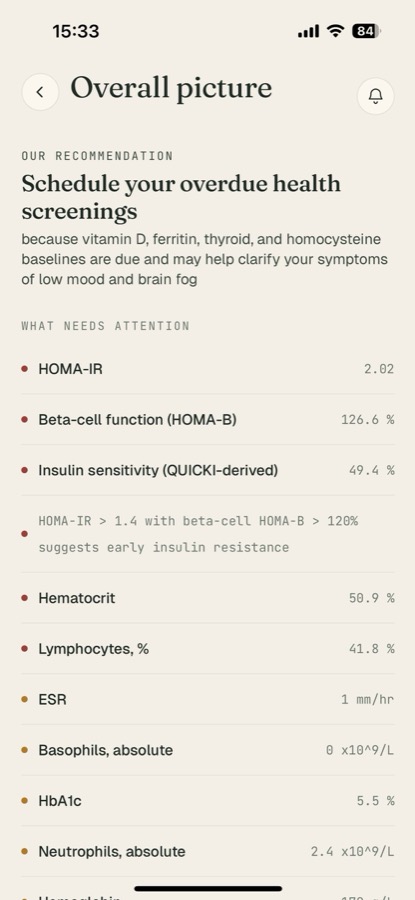
This is the part a single result cannot give you. Bevita keeps every lab report you upload with its date, so your TSH becomes a line rather than a number — and reads it next to free T4 and the symptoms you log instead of in isolation.
Upload the report this value came from and you will see where 0.5 sits against your own history, not just against a reference range built from strangers.
Related reading
- the six markers behind most persistent fatigue
- free T3 and free T4 explained
- what low ferritin actually means
Nearby TSH values
- TSH 0.05 Deeply suppressed
- TSH 0.1 Clearly below range
- TSH 0.3 Just below range
- TSH 1.5 Mid-normal
- TSH 2.5 Upper-middle of normal
- TSH 3.5 High-normal
References
- National Institute of Diabetes and Digestive and Kidney Diseases. Hypothyroidism.
- Pierce E, et al. Physiology, Thyroid Stimulating Hormone. StatPearls, NCBI.
This page is for education and isn't medical advice. Reference ranges vary between laboratories — check the range printed on your own report, and discuss your results with a qualified clinician.
Frequently asked questions
- Is a TSH of 0.5 normal?
- Yes — 0.5 mIU/L falls inside the usual reference range of about 0.4 to 4 mIU/L, so it is reported as normal. Ranges vary slightly between laboratories, and this value sits in the low end of normal part of that range.
- Does a TSH of 0.5 need treatment?
- Nothing to treat. If you take thyroid medication and feel over-stimulated — jittery, sleeping poorly, heart racing — it is worth reviewing the dose against this result rather than assuming it is unrelated.
- What should I test alongside a TSH of 0.5?
- Free T4, if you take thyroid medication, to check you are not over-replaced, Ferritin, vitamin D and B12 if you have symptoms, since a normal TSH points elsewhere. TSH on its own cannot separate the pituitary's signal from the thyroid's actual output, which is why free T4 is the usual companion test.
See what your TSH has actually been doing
Upload your lab reports to Bevita and it tracks your TSH and free T4 across every test, reads them together, and ties them to how you've been feeling. Free to start.
Download on the App Store