If you searched for “hyperthyroidism and high TSH,” here’s the quick correction that clears up a lot of confusion: an overactive thyroid usually makes your TSH LOW, not high. It’s one of the most common mix-ups in reading thyroid labs, and it comes down to which direction the feedback loop runs.
Why the numbers move the way they do
TSH is the pituitary’s instruction to the thyroid — and it moves opposite to your actual thyroid hormone:
- Overactive thyroid (hyperthyroidism) → too much T3/T4 → pituitary stops signaling → TSH drops (low/suppressed).
- Underactive thyroid (hypothyroidism) → too little T4 → pituitary signals harder → TSH rises (high).
So the mental shortcut: low TSH = overactive, high TSH = underactive. If your TSH is high, that points to an underactive thyroid, which is the opposite of hyperthyroidism.
The stat most people don’t know
Graves’ disease — an autoimmune condition — is the most common cause of hyperthyroidism, accounting for roughly 60–90% of cases, and it’s about five times more common in women than men (Medscape; Prevalence of Thyroid Disease, ScienceDirect). In Graves’, the immune system stimulates the thyroid directly, so hormones run high while TSH is pushed down to nearly nothing.
What the hyperthyroid pattern looks like
- TSH: low or fully suppressed (often below 0.1)
- Free T4 and/or free T3: high
- Symptoms: rapid heartbeat, weight loss, heat intolerance, anxiety, tremor, trouble sleeping
That’s the mirror image of the underactive picture — where everything slows down instead of speeds up.
The one confusing exception
There’s a rare pattern where TSH is normal or even high with high thyroid hormones — central hyperthyroidism (for example, a TSH-secreting pituitary tumor). It’s uncommon and needs specialist evaluation. If your labs genuinely show both TSH and T4 high, that’s the scenario to have a clinician look at — but it’s the exception, not the rule.
What this looks like in Bevita
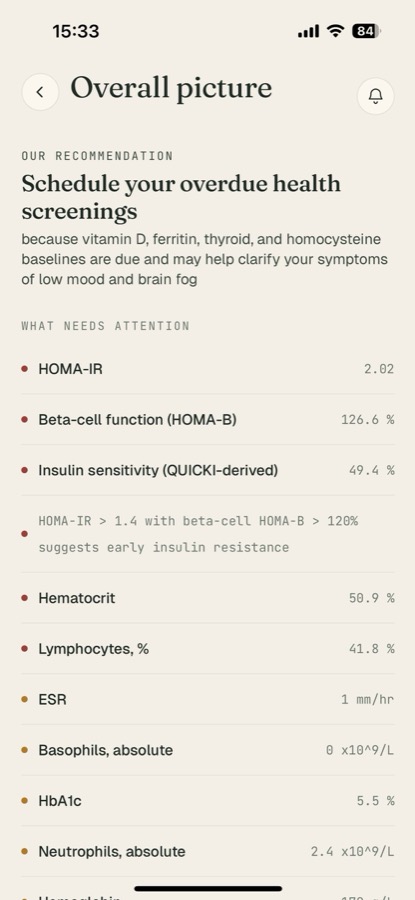
The direction of your thyroid numbers only makes sense when TSH and free T4/T3 are read together. Bevita tracks them side by side, so a suppressed TSH with high free T4 reads clearly as the hyperthyroid pattern — and you can see the trend over time rather than trying to interpret one number in isolation before an appointment.
What to do
- Match the pattern — low TSH + high T4/T3 = overactive; high TSH = underactive.
- Get free T4 and free T3 alongside TSH to confirm the direction.
- Ask about the cause — Graves’ is the most common; antibody testing helps.
- Talk to a clinician — hyperthyroidism needs proper diagnosis and treatment.
References
- Medscape. Graves Disease: Background, Etiology, Pathophysiology.
- Prevalence and Trends of Thyroid Disease Among Adults. ScienceDirect / Endocrine Practice.
- American Thyroid Association. Hyperthyroidism.
This article is for education and isn’t medical advice. Discuss your results with a qualified clinician.
Track your thyroid with Bevita
Thyroid numbers make sense when read together and over time. Upload your labs to Bevita and it tracks TSH with free T4 and T3, flags whether the pattern is over- or underactive, and shows the trend. Download Bevita, upload your thyroid results, and read the direction correctly.