TSH 100: What This Level Means
A TSH of 100 indicates severe, long-standing hypothyroidism that needs prompt care. What it means, what causes it, and which tests come next.
Severe hypothyroidismWhere 100 sits
At 100 mIU/L you are 96 above the 4 ceiling of the reference range — roughly 25× the upper limit — and past the 10 mark where treatment is usually recommended.Values at this magnitude are not reached quickly. Getting from the top of normal to 100 means the pituitary has been escalating its signal for a long stretch, which is itself part of what the number tells you.
| Your value | 100 mIU/L |
|---|---|
| Usual reference range | 0.4 – 4 mIU/L (varies by lab) |
| Where it falls | Severe hypothyroidism |
| Treatment threshold | Usually around 10 mIU/L for an underactive thyroid |
What a TSH of 100 means
A TSH this high is not a borderline finding. It indicates severe hypothyroidism, and because the number climbs gradually, a value here points to a thyroid that has been substantially underactive for a long time — frequently many months to years.
Free T4 is usually clearly low and symptoms are typically marked: profound fatigue, cold intolerance, a slowed heart rate, dry skin, hoarseness, constipation, low mood, sometimes puffiness around the face and hands.
Occasionally an extreme value reflects something other than the gland itself — assay interference, or rarely a pituitary problem driving inappropriate TSH production. Those are uncommon, and the practical response is identical: get it assessed quickly rather than repeated in six months.
What causes a TSH this high
- Long-standing untreated Hashimoto's thyroiditis
- Thyroid replacement stopped or never started, including absorption failure
- After thyroidectomy or radioiodine with no adequate replacement
- Severe iodine deficiency, in affected regions
- Assay interference or a pituitary cause — rare, considered when the picture does not fit
Does a TSH of 100 need treatment?
Replacement is indicated and should be started and monitored by a clinician. Cautious dose escalation is the norm in older people and anyone with cardiac disease, since rapid correction of a long-standing deficit can precipitate angina or arrhythmia.
What to test alongside it
- Free T4 — expected to be clearly low
- TPO antibodies to confirm the cause
- Sodium, lipids, creatine kinase and a full blood count, commonly abnormal in severe hypothyroidism
- Cortisol, if a pituitary cause is suspected
How soon to act
Seek medical attention promptly. Severe untreated hypothyroidism has real complications, and it treats well once identified.
Why one reading is never the whole story
TSH moves. It peaks overnight and early in the morning, shifts with illness and with the laboratory doing the measuring, and responds slowly to any real change — which is why a single value of 100 is a starting point rather than a conclusion. The same number means one thing if it has been stable for years and something quite different if it has been climbing across your last three tests.
What this looks like in Bevita
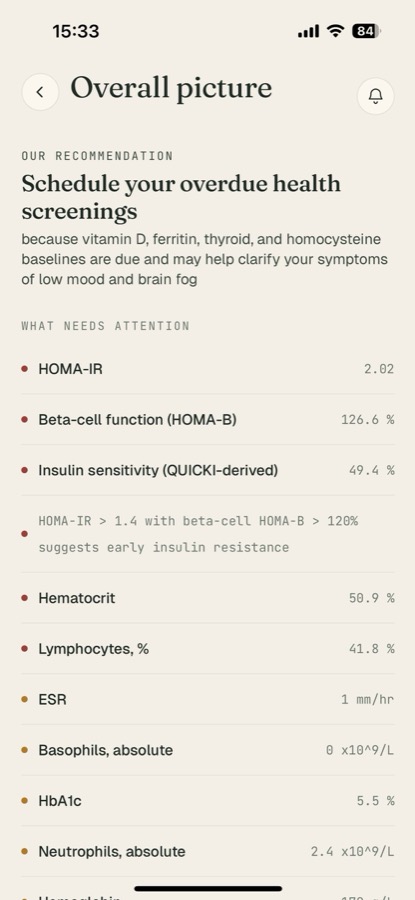
This is the part a single result cannot give you. Bevita keeps every lab report you upload with its date, so your TSH becomes a line rather than a number — and reads it next to free T4 and the symptoms you log instead of in isolation.
Upload the report this value came from and you will see where 100 sits against your own history, not just against a reference range built from strangers.
Related reading
- what a TSH over 100 means
- what an underactive thyroid feels like
- high TSH: what your thyroid is telling you
Nearby TSH values
- TSH 8.8 Approaching the treatment threshold
- TSH 11 Overt hypothyroidism range
- TSH 30 Marked hypothyroidism
References
- National Institute of Diabetes and Digestive and Kidney Diseases. Hypothyroidism.
- American Thyroid Association. Hypothyroidism.
- Pierce E, et al. Physiology, Thyroid Stimulating Hormone. StatPearls, NCBI.
This page is for education and isn't medical advice. Reference ranges vary between laboratories — check the range printed on your own report, and discuss your results with a qualified clinician.
Frequently asked questions
- Is a TSH of 100 normal?
- No — 100 mIU/L falls outside the usual reference range of about 0.4 to 4 mIU/L. It sits in what is generally described as the severe hypothyroidism. Reference ranges do vary between laboratories, so compare against the range printed on your own report.
- Does a TSH of 100 need treatment?
- Replacement is indicated and should be started and monitored by a clinician. Cautious dose escalation is the norm in older people and anyone with cardiac disease, since rapid correction of a long-standing deficit can precipitate angina or arrhythmia.
- What should I test alongside a TSH of 100?
- Free T4, TPO antibodies to confirm the cause, Sodium, lipids, creatine kinase and a full blood count, commonly abnormal in severe hypothyroidism, Cortisol, if a pituitary cause is suspected. TSH on its own cannot separate the pituitary's signal from the thyroid's actual output, which is why free T4 is the usual companion test.
See what your TSH has actually been doing
Upload your lab reports to Bevita and it tracks your TSH and free T4 across every test, reads them together, and ties them to how you've been feeling. Free to start.
Download on the App Store